International Journal of Disaster Risk Reduction | Volume 114, November 2024, 104924
Margarita Garfias Royo, Imaduddin Ahmed, Ella Meilianda, Priti Parikh
Highlights
- Our recommendations help practitioners mitigate risk and improve conditions for girls in Indonesian schools post-disaster.
- Inadequate WASH facilities may exacerbate girls’ experiences of psychological distress post-disaster.
- This mixed methods study the need to understand local needs for developing resilient WASH recovery.
- Physical interventions need to be coupled with behavioural changes to be effective.
Small-scale WASH interventions have the potential to have a big impact in girls’ education.
Abstract
Access to functional and clean toilets which maintain privacy and dignity and support girls’ Menstrual hygiene management (MHM) plays a crucial role to getting girls back to school post-disaster. This could also help in managing feelings of shame and disgust experienced when using toilets in schools in post disaster settings. In this paper, we report on our assessment of water, sanitation and hygiene (WASH) facilities in schools three-years post the 2018 multi-hazard event in Indonesia. We used a mixed-methods approach using visual observations, interviews with school principals, surveys with schoolgirls and focus group discussions with schoolgirls and teachers to understand the lived experiences of students using toilets at school. Our results highlight that across schools descriptive and injunctive social norms were supportive of littering, inadequate toilet facilities for girls to manage their menstruation and bullying and antisocial behaviour by opening toilet doors while the facilities were occupied. Based on these results, we developed two types of interventions, physical and behavioural, piloted in three schools to increase WASH and MHM awareness and the safety of sanitation facilities. Our interventions showed that approaches for WASH interventions in schools can only be designed if we understand the local barriers to carrying out interventions that integrate maintenance plans. We provide recommendations to support practitioners in mitigating risk and improving circumstances for girls in schools in Indonesia, which have the potential to address SDG 4 on inclusive and equitable education and SDG 5 on gender equality and girls’ empowerment.
To read the full article, click here.
Conclusions
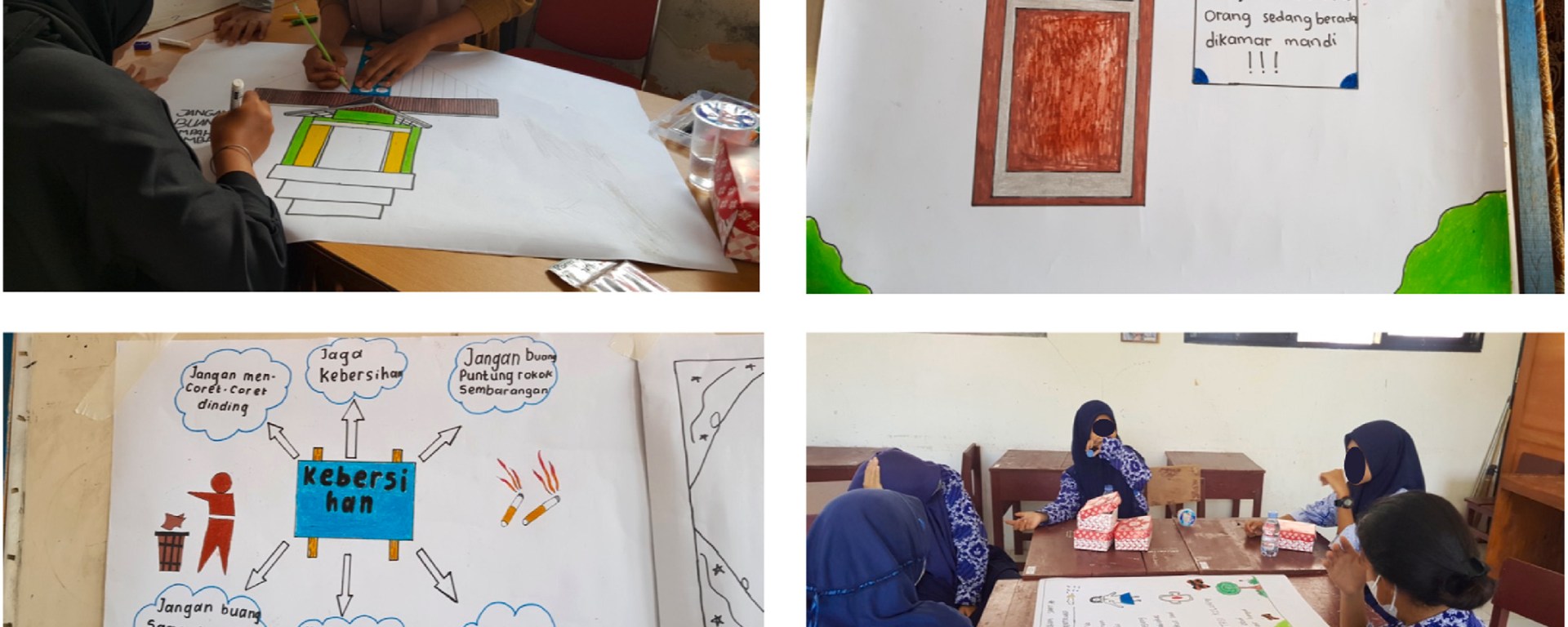
We conducted mixed-methods to understand the lived experiences of students using toilets at school, particularly girls, objectively assess the WASH facilities at schools and how adequate recovery interventions had been three-years post disaster. Our results highlighted that across schools descriptive and injunctive social norms were supportive of littering, antisocial behaviour and bullying by opening toilet doors while the facilities were occupied. Based on these results, we carried out two types of interventions, physical and behavioural interventions, tested in three schools. Our interventions showed that approaches for WASH interventions in schools can only be sustainable if local barriers to carrying out interventions that integrate maintenance plans are understood. We faced several limitations to carry out interventions, including COVID-19 restrictions, a limited budget, change in staff of in-country partners and their limited availability. This posed limitations for the creation of waste disposal plans for the bins distributed to schools. Additionally, school administrations, while initially on board, decided to not display the posters designed created with and by schoolgirls. Nonetheless, there is a need to increase awareness on the importance of toilet cleanliness and MHM, to support teenage girls to manage their feelings of shame and disgust experienced while using toilets at school during the period of menstruation. Based on our results, we put forward suggestions that could support the improvement of WASH conditions as well as physical and behavioural interventions at school level which could help improve water availability, safer hygiene and sanitation, which ultimately impacts how girls manage their menstruation while at school. Improving access to safe water and sanitation for girls in menarche age in school settings has the potential to address several targets of the Sustainable Development Goals at once, particularly SDG 4.1 on ensuring all girls complete their secondary education, SDG 4.5 on gender disparities in education and SDG 4.a on upgrading facilities to provide safe and inclusive learning environments as well as SDG 5.1 on ending all forms of discrimination against girls, 5.6 on ensuring universal access to sexual and reproductive health and 5.c on adopting policies for the promotion of gender equality and empowerment of schoolgirls.
 energy and a just transition