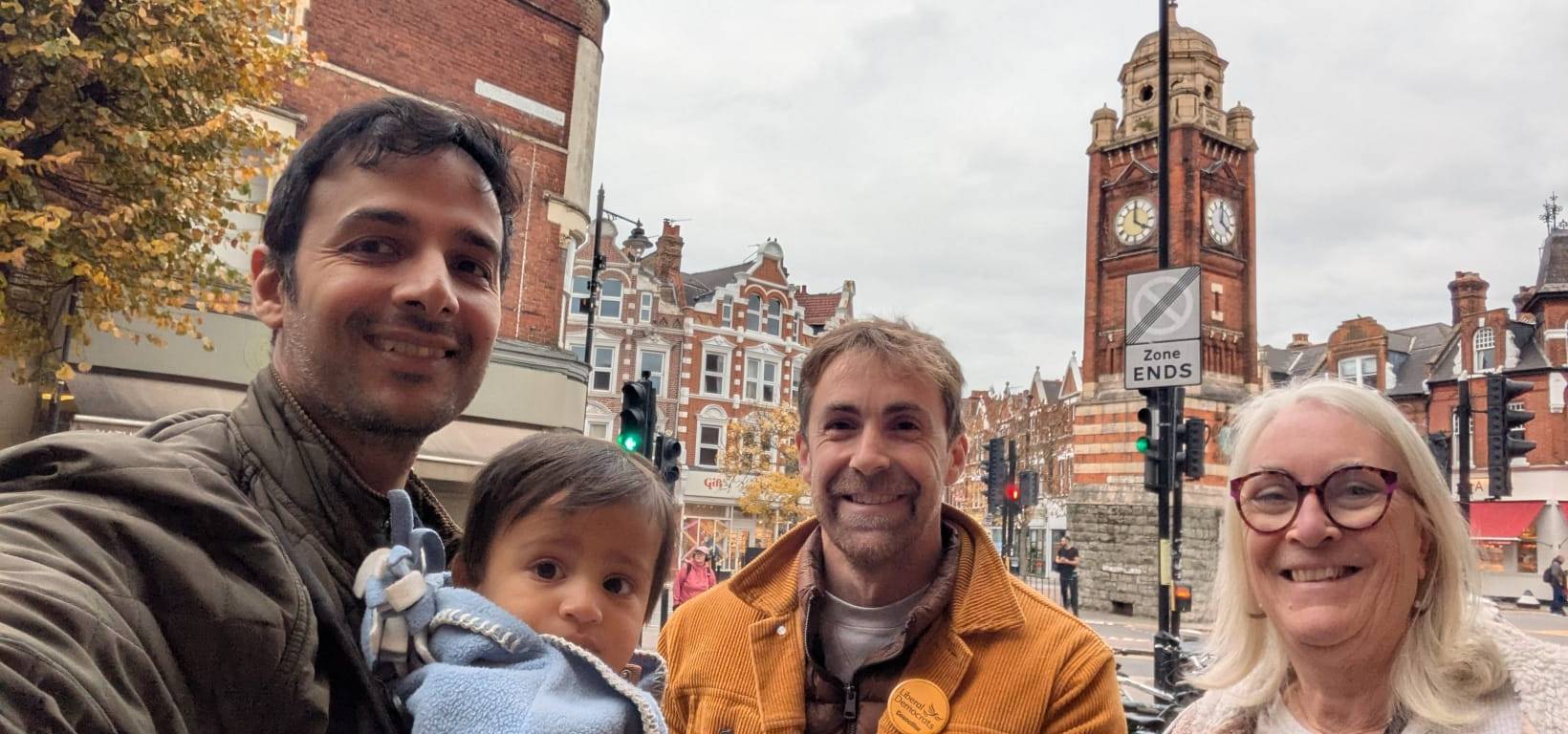
It’s been a week since I was given my Council badge and devices. So far, I’ve filed a Member’s Enquiry on behalf of a disabled resident whose housing application was incorrectly rejected; visited an elderly resident to measure her neighbour’s new fence height and show her how to initiate a planning complaint; filed 21 dog mess reports; and started getting to grips with two planning applications and a complex school issue.
I’m enjoying the immediacy of being a local representative – being able to work on problems that tangibly affect people’s day-to-day lives.
But public service does not stop at the borough boundary. Elected representatives have a moral duty not only to serve their local communities, but also to speak out when their national government is supporting genocide in plain sight. Here’s my second comms intervention of the week on Palestine and how the Liberal Democrats failed to cut through to people who could have voted for us.
Lib Dem Voice | Imaduddin Ahmed | 18 May, 2026
The fallout from this year’s local elections has sparked an important conversation about where our Party goes next. I was recently one of just eight Lib Dem candidates elected to the Council in Haringey, where we worked the soles off our shoes to win twenty-one seats from a base of seven. Without any door-knocking, the Green Party won one of our safest seats and set us back in others. Our experience has been mirrored in other metropolitan areas full of disaffected Labour voters, including other boroughs of London, Manchester (see Jonathan Moore’s “What did the Greens have that we didn’t” and Shaun Ennis’ “Standing Still”), Sheffield, Bradford and Birmingham.
In contrast to the Greens, we lacked coherent national messaging. Apart from Ed boycotting the King’s banquet for Trump over Gaza, which was mentioned positively at the door, we ceded ground to the Greens on agreed upon Lib Dem policy. Erstwhile Lib Dems told me that they didn’t see the Party on the screen, nor know what we stood for any longer. Even an affluent progressive voter told me she felt unrepresented.
By contrast, the Greens have been far more successful at projecting a coherent, values-based identity. Voters saw Zack Polanski as bold, willing to challenge injustice and take clear positions, even where doing so carries political risk.
Palestine is clearly part of that picture.
Voters are looking to be inspired by parties willing to stand up consistently for international law and a values-based foreign policy. The Greens’ vocal and highly visible stance on Palestine has enabled them to fill that space, and there is growing evidence that this has translated into electoral gains in Labour-facing urban areas where we might otherwise have advanced.
In Birmingham, for example, the Greens climbed from 2 seats to 19 while the Liberal Democrats remained static at 12, despite expectations that we would emerge as the main opposition to Reform. This must surely bear some relation to the Greens’ greater clarity on Palestine in a city with four universities, a highly educated Labour vote, and many Muslims, who feel besieged by anti-Muslim Labour and Tory messaging, never mind Reform.
In west Haringey where I met only a few Muslims, I nevertheless spent significant time speaking about Palestine at the door. When I explained that the Lib Dems have called for the immediate recognition of Palestine since 2017, stand by international courts, and call for an arms ban and no trade with illegal settlements, this led to encouraging conversations with once Labour voters. Even on election day, a disaffected Labour activist wasn’t going to vote until we spoke. She later confirmed she had, and I asked her to hold me to account.
Committee members in Birmingham and elsewhere in London report similar experiences: Palestine is not a marginal issue, but one increasingly shaping how some voters – particularly young people, ethnic minorities and soft-left voters – are making electoral choices.
That such voters are turning to the Greens should worry us – not simply for electoral reasons, but because the Liberal Democrats are naturally well placed to speak to their concerns. As a Party rooted in internationalism, human rights and the rule of law, we ought to be capable of articulating a confident and consistent position on one of the defining moral issues of our time.
On paper, our position on Palestine is strong. Unlike Labour or the Conservatives, our leadership acknowledges that Israel has committed genocide in Gaza and our policies call for tougher measures to end the illegal occupation. Our MPs have consistently pressed ministers on the Government’s inaction. But strong positions matter little if voters do not hear them.
This reflects a wider tendency within the Party to play it safe on progressive issues for fear of alienating Conservative-facing voters. Whether on immigration, LGBTQ+ rights or foreign policy, we can seem reluctant to enter difficult debates or speak with clarity and confidence on complex social problems. Meanwhile, the Greens have shown that there is political as well as moral value in communicating principled positions clearly, consistently and visibly.
The lesson from these elections is not that the Liberal Democrats need to change who we are. It is that we need to be far more confident in communicating what we already believe. If we fail to do so, we should not be surprised when voters who share our values look elsewhere.
* Imaduddin Ahmed is a newly elected Councillor for Crouch End in the London borough of Haringey, and is a member of the Liberal Democrat Friends of Palestine Executive Committee.
More on how I came to the Lib Dems via Palestine.

